
Author: PT Evelina — Level 3 Personal Trainer (CIMSPA & EREPS Registered)
Experience: Fitness instructor since 2018, 10 years handball athlete, fitness competitor 2012–2013
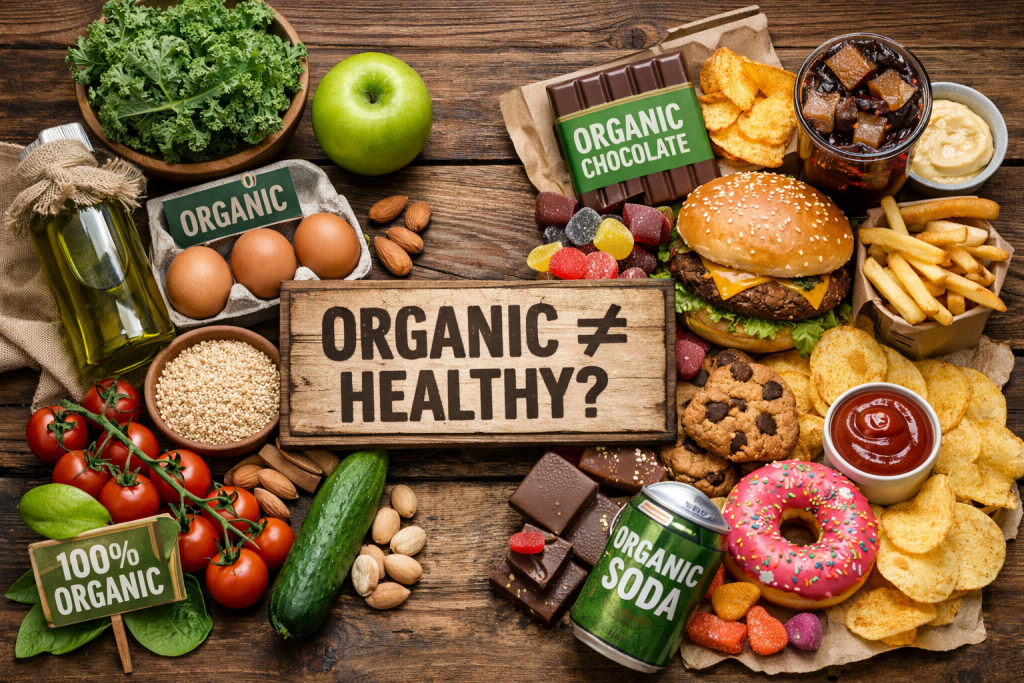
Walk into any supermarket and you’ll see it everywhere: organic biscuits, organic crisps, organic chocolate, organic ready meals.
They look wholesome. They sound safe. They feel like a better choice.
But here’s the uncomfortable truth — and I promise I’m not being dramatic:
Organic does not automatically mean healthy.
And no, this isn’t a “fitness industry opinion”. This is what the science actually says.
Why This Illusion Is So Convincing
The word organic quietly whispers:
“You’re doing the right thing.”
No chemicals. Better quality. Safer for your body.
So when life is busy, kids are hungry, and you’re trying to be a responsible adult, grabbing the organic version feels like a win.
Food companies know this. And they lean into it hard.
The problem?
Your body doesn’t process food based on labels. It responds to nutrients.
Here’s the Part No One Likes to Hear
Organic Sugar Is Still Sugar
Organic cane sugar. Organic coconut sugar. Organic agave.
Different names. Same job in your body.
Research published in The American Journal of Clinical Nutrition shows that blood sugar and insulin responses depend on how much and what type of carbohydrate you eat — not whether it’s organic.
Your pancreas doesn’t pause and say:
“Oh, this one’s organic. We’ll react gently.”
It reacts exactly the same way.
Organic Junk Food Is Still Junk Food
This one surprises people.
Organic biscuits. Organic crisps. Organic protein bars with 18 ingredients and a wellness font.
Large-scale research published in The BMJ links ultra-processed foods to higher risk of weight gain, metabolic issues, and cardiovascular disease — even when ingredients are organic.
If it’s highly processed, easy to overeat, and low in fibre… organic doesn’t cancel that out.
“But It Has Vitamins Added…”
Ah yes. The fortified illusion.
Many organic products are nutritionally weak but topped up with:
- added vitamins
- minerals
- protein powder
This looks impressive on the front of the packet.
But studies consistently show that supplements don’t replicate the benefits of whole foods — especially fibre, satiety, and digestion.
Poor nutrition with added supplements is still poor nutrition.
Calories Still Matter (Sorry)
This isn’t popular, but it’s true.
Organic oils, nut butters, granola, chocolate — all very easy to overconsume.
Research and guidance from Harvard T.H. Chan School of Public Health shows that weight management still depends on:
- overall energy intake
- protein
- fibre
- food structure
There’s even a well-documented “health halo effect”: people eat more of foods labelled organic or healthy because they feel safer.
Organic calories are still calories.
“So… Is Organic Basically a Scam?”
No. And this is important.
Organic farming can be beneficial:
- lower pesticide exposure
- environmental considerations
- animal welfare (especially meat & dairy)
But here’s the key point:
Organic is a farming method — not a nutrition guarantee.
Even organisations like the World Health Organization and the NHS focus their dietary guidance on:
- balanced meals
- fibre intake
- protein
- limiting ultra-processed foods
Not on organic labels.
What Actually Makes Food “Healthy”
If I had to strip it down to basics — the stuff that actually moves the needle — it’s this:
- enough protein
- enough fibre
- mostly whole or minimally processed foods
- portions you can repeat daily
- consistency over perfection
A 2024 review in Nutrients confirmed that overall dietary pattern matters far more than whether foods are organic.
You can eat an organic diet and still feel tired, hungry, inflamed, and stuck.
You can eat mostly non-organic whole foods and thrive.
The Real Takeaway (No Guilt Version)
Organic food isn’t bad.
But organic isn’t a shortcut.
It doesn’t cancel sugar.
It doesn’t neutralise ultra-processing.
It doesn’t override basic physiology.
Healthy eating isn’t about choosing the purest-sounding option.
It’s about choosing what actually supports your body — day after day.
And once you see that?
You’ll never look at supermarket labels the same way again 😉
Sources
-
Annals of Internal Medicine
Smith-Spangler C. et al.
Are Organic Foods Safer or Healthier Than Conventional Alternatives?
Systematic review and meta-analysis of 200+ studies showing no consistent nutritional advantage of organic foods. -
The American Journal of Clinical Nutrition
Research on glycaemic response and carbohydrate metabolism demonstrating that blood sugar and insulin response depend on carbohydrate type and quantity, not organic status. -
The BMJ (2023–2024 reviews)
Studies linking ultra-processed food consumption to obesity, cardiovascular disease, and metabolic disorders — regardless of organic labelling. -
Nutrients (2024)
Systematic reviews concluding that overall dietary pattern is far more important than organic food choice alone for health outcomes. -
Harvard T.H. Chan School of Public Health
Evidence-based guidance on healthy eating, weight management, calorie balance, and the “health halo” effect in food marketing. -
World Health Organization
Healthy Diet Fact Sheets
Emphasises balanced diets, fibre intake, and limiting sugar and ultra-processed foods — no recommendation that organic food is inherently healthier. -
NHS
Eatwell Guide & Healthy Weight Guidance
UK public health guidance focusing on nutrient balance, portion control, and long-term habits rather than food labels.