
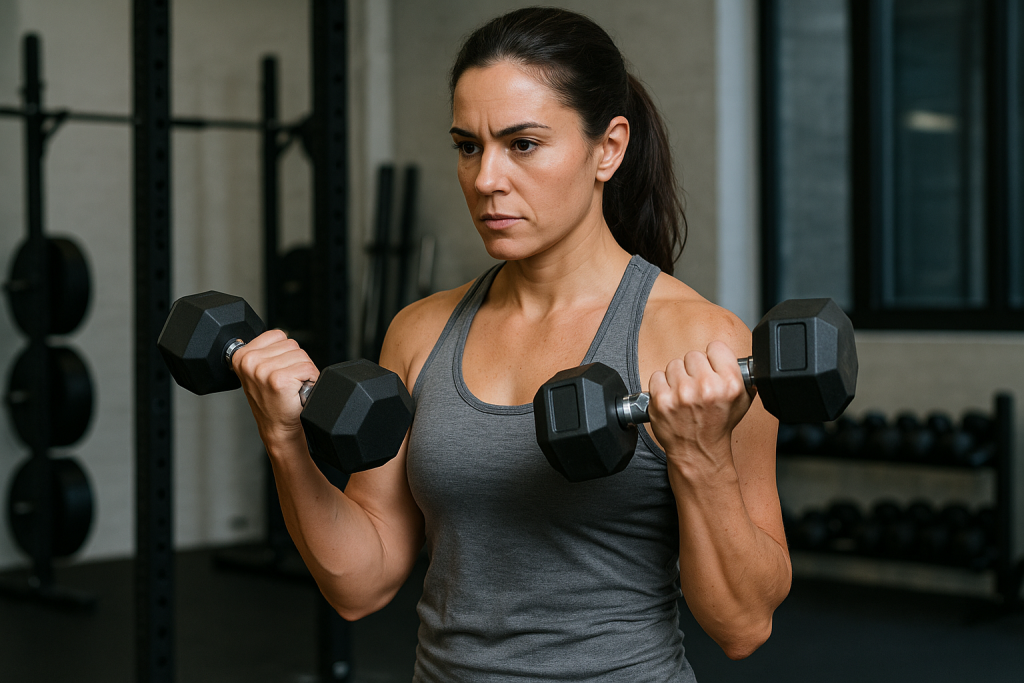
Why you might be thinking twice
Maybe you’ve heard that lifting weights is optional — that cardio or “just moving more” is enough. Or perhaps you’re worried: “If I start lifting weights, will I get bulky like a body-builder?”
Here’s the truth: strength training is not optional if you want sustainable results in terms of fat-loss, muscle tone, metabolic health and longevity. And the good news? The “bulk up” fear is mostly a myth for most women.
Why strength training really matters
1. Muscle matters for metabolism & ageing
As women age (especially past 30 – 35), lean muscle mass gradually declines. Studies show muscle-mass loss leads to a slower resting metabolic rate, making it harder to maintain or lose weight. Strength training helps reverse or slow that loss. Lippincott Journals+1
Similarly, regular resistance training improves metabolic health, bone density, insulin sensitivity and functional strength. Mayo Clinic+1
2. Women see major health-benefits from strength work
New research shows women may derive even greater relative benefit from strength training compared to men. For example, one large study found women who did strength training had up to a ~30 % lower risk of cardiovascular-related death. NHLBI, NIH+1
Another study found women who engaged in resistance training improved lean body mass, muscle strength and functional outcomes during the transition through menopause. University of Exeter News
3. Strength training isn’t just about big muscles
When you hear “strength training” you probably imagine heavy barbells, big muscles, bulging biceps. But for most women, strength training simply means: using resistance (weights, bands, body-weight) to challenge your muscles. The outcome? A firmer, more capable body, better posture, less injury risk, more energy — not unwanted bulk.
The research shows moderate resistance training can improve body composition (higher lean mass, lower fat mass) without necessarily increasing total size in a dramatic way. mdpi.com+1
Will lifting weights make me “bulk up”? Clarifying the myth
Myth: “I’ll look like a male body-builder”
In reality: A female body has far lower testosterone and different hormonal milieu than male body-builders; the typical woman does not naturally have the hormonal environment needed to create huge muscle mass quickly. Gaining large, bulky muscles usually requires specific programming, high volume, very heavy loads, often years of training, plus dietary support and genetics.
For most women, especially if time-poor (like many busy women in their 30s-40s), lifting weights will produce toning, strength and shape — not bulk.
What causes “bulk” and how you avoid it
If you’re concerned about bulking up, keep these in mind:
Training volume & load: Very high volumes and heavy loads (many sets, many times per week) push hypertrophy (large muscle growth) more than moderate strength work.
Diet & calorie surplus: Building big muscles generally requires a consistent calorie surplus and high protein + training stimulus. If you’re calibrating for fat-loss (or maintenance), you’re unlikely to build lots of extra muscle size.
Individual genetics: Some women naturally respond with more visible muscle size than others, but even then “bulk” is relative and usually slower.
What to focus on instead
Choose moderate loads (e.g., weights where you can do 8–15 reps) 2-3 times/week for general strength & shape.
Prioritise form, progression, consistency rather than maxing out every session.
Combine strength training with good nutrition, adequate recovery and believe that shape, tone and functional strength are the real goals.
How to include strength training in your routine
Schedule 2 strength sessions per week (even 20–30 min counts) focusing on major muscle groups (legs, back, chest, shoulders).
Pick compound movements: squats or lunges, push-ups or chest press, rows or pull-downs, planks or deadlifts.
Use progressive overload: gradually increase weight, reps or challenge (bands, tempo) to keep your body adapting.
Complement with cardio and mobility: Strength training is best combined with movement variation — walking, interval cardio, stretching — for full health benefits.
Track and adjust: Monitor how you feel, move, sleep, energy levels — your goal is functional strength, better shape, increased confidence — not just a number on the scale.
Conclusion
Yes — strength training is necessary if you want to build a strong, resilient body that works for you beyond your 20s. And no — you will not automatically “bulk up” in an unwanted way simply by lifting weights. The result you’re likely to see is more strength, better posture, leaner shape, improved metabolism and greater health.
If you want help designing a routine that fits your lifestyle, I’d love to support you. Together we’ll build strength smartly, with a plan that respects your goals and your time.
Sources
“Women may realise health benefits of regular exercise more than men” (NHLBI, 2024) – NHLBI, NIH
“The Many Benefits of Resistance Training as You Age” (Mayo Clinic, 2024) – Mayo Clinic McPress
“The Unique Benefits of Strength Training for Women” (University Hospitals blog, 2024) – University Hospitals
“Dose-response effects of 8-week resistance training on body composition …” (LWW / MD Journal, 2024) – Lippincott Journals
“Strength Training: Get Stronger, Leaner, Healthier” (Mayo Clinic – Strength Training article) – Mayo Clinic